Archive for the ‘Digital Art’ Category

Atmospheric Disturbance Added to Computer Art Gallery

Tuesday, February 2nd, 2010

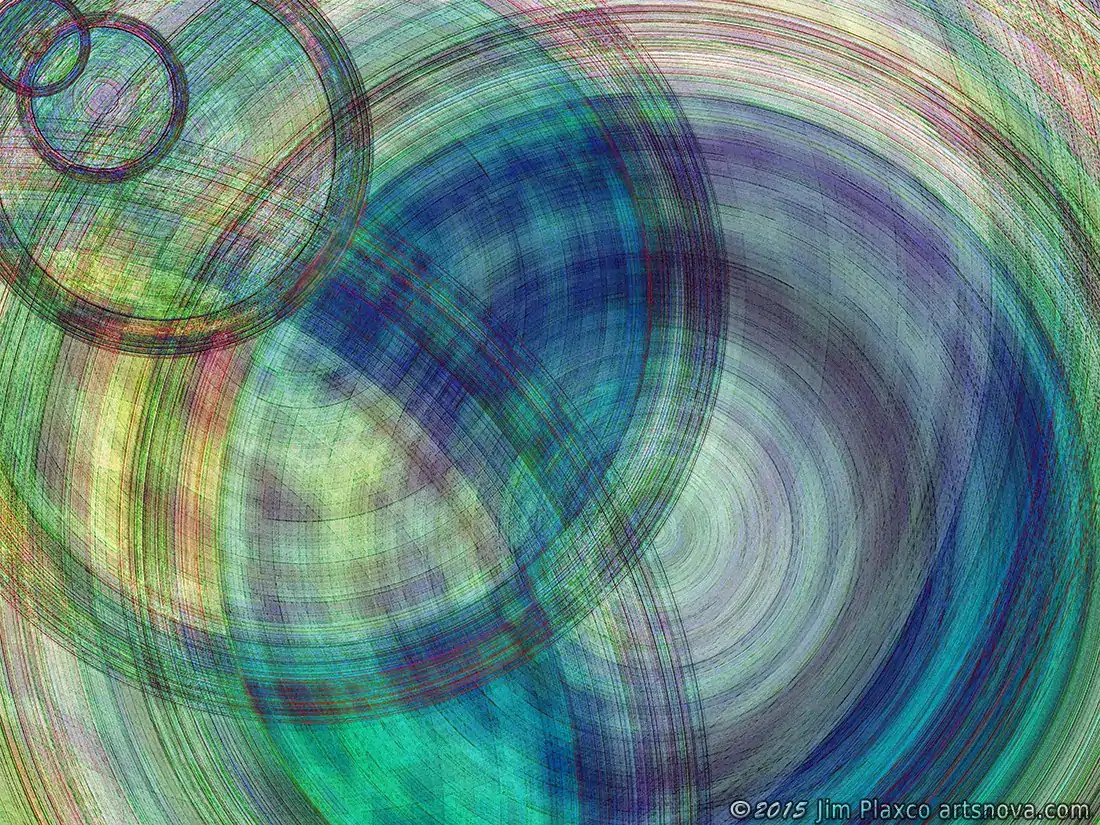
Atmospheric Disturbance computer art

I just finished adding another work of art to my web site. Atmospheric Disturbance is a piece I created earlier this month and which I’ve added to my Computer Art Gallery.

The piece came about as a consequence of considering the invisible turbulence that a particle, ball, or planet creates when moving through some intangible medium. Actually it all started with thinking about that old idea that there was an invisible ether that permeated all space and which would affect the speed of photons as they moved through that medium.

I added Atmospheric Disturbance to my Computer Art Gallery because of the tools and workflow used to create this piece. This piece was created using a combination of my own personal computer graphics software and Adobe Photoshop.

I must confess that one of the reasons that I make use of my own software dates back to a number of years ago when I would be walking through the art shows at science fiction conventions. At that time the range of graphics software used by digital artists was less diverse than today and I prided myself on being able to correctly identify the software the artist used in the creation of their artwork. Especially easy to identify were those pictures created using either Bryce or Poser.

To escape being typecast it seemed best to avoid using mainstream software - Adobe Photoshop being the principal exception. It also seemed like a good idea to diversify and to not become too dependent on any one software package - once again with Adobe Photoshop being the exception.

In the early days I would write using the C programming language. Once Java came along I began using that language. In fact I’m proud to say that I used Java to create the first (as far as I know) web accessible database of Martian feature names which included cross references to Viking images. Java has changed substantially since then. Some recent and useful books on graphics programming with Java are:

In addition to Java, I also make use of a great extension to Java called Processing. While the Java programming language can be pretty intimidating, that is not the case with Processing and I highly recommend it to anyone even remotely interested in doing their own graphics programming. To learn more visit the Processing web site.

I seem to be getting off topic here so to conclude, for a better view of Atmospheric Disturbance, you should visit the Atmospheric Disturbance web page which has a link to a wallpaper sized version of the image.

Look for another new art addition tomorrow

Jim.

Bookmark it:  Stumble It  Bookmark this on Delicious  Digg This  Technorati  Reddit Tweet It


Life Pulse - New Digital Abstract Art

Monday, February 1st, 2010

Life Pulse abstract art

I must confess. I’ve not been very good at adding art, either old or new, to my web site. In fact I have a rather large backlog for each of the genres of art that I create. To make amends I plan to focus on adding my newest works of art over the coming weeks. The bulk of this art will be added to my Computer Art Gallery.

The first piece I am adding is Life Pulse. This work is currently on display at the Advocate Good Shepard Hospital in Barrington IL as a part of an exhibit of a selection of my digital art. For more, see Art Exhibit at Advocate Good Shepard Hospital in Barrington IL

Additional information about this digital painting and a wallpaper sized version are at Life Pulse abstract art page. Given that the original is 20 inches wide by 15 tall, not much detail is apparent in the wallpaper sized version. It does however provide a good representation of what the full size artwork looks like.

Check back in a day’s time to see what gets added next. And no, I haven’t yet decided what to add next.

Bookmark it:  Stumble It  Bookmark this on Delicious  Digg This  Technorati  Reddit Tweet It


Diffusion Limited Aggregation

Thursday, August 27th, 2009

Diffusion Limited Aggregation
Figure 1.Diffusion Limited Aggregation Graphic

Over the weekend I spent some time experimenting with Diffusion Limited Aggregation. In computer graphics Diffusion Limited Aggregation is a method for growing or creating shapes that have a nature-made quality and which have a fractal dimension. In nature, this type of growth is seen in coral reefs and crystals. Note the dendritic structure in the illustration above - which reminds me somewhat of ice crystals on a window pane. The concept’s origin is with the paper Diffusion-Limited Aggregation, a Kinetic Critical Phenomenon by T. A. Witten and L. M. Sander that appeared in an 1981 issue of Physical Review Letters.

The growth of structure seen when using the Diffusion Limited Aggregation method results from the random deposition of particles on a surface. The basic rule is that whenever a moving particle finds itself adjacent to a stationary particle, it too becomes stationary and a new moving particle is created to take its place. A typical growth simulation will start off with one or more seed particles - particles which are already stationary. A number of moving particles are then added to the system. The movement of the individual particles is random.

The random motion that the particles undergo is described as a random walk. The path that an individual particle takes is determined by a random process with the two components being direction and distance (think vector). In my implementation of random motion, collisions between moving particles was ignored. The nature of the random walk is related to Brownian motion. Brownian motion is the type of movement exhibited by particles suspended in a liquid medium. Figure 2 below shows the random motion of three particles using the same algorithm as used in the Diffusion Limited Aggregation process that created the growth in the Figure 1.

Brownian Motion example
Figure 2.An example of Brownian Motion

As you can see in Figure 1, the Diffusion Limited Aggregation growth is rather symmetrical. This particular growth would have been more symmetrical except that there were additional growths, cropped out of the image shown, that captured particles that would have otherwise been deposited on the growths shown. There are several other ways to obtain non-symmetrical growths. One method for achieving directional growth is by omitting one or more of the eight moveable directions on the rectangular grid. Another method would be a preferential bias in the detection of adjacent stationary particles.

Diffusion Limited Aggregation can be a very inefficient way, in terms of CPU cycles, to generate growths. Depending on the size of the playing field, the number of seeded stationary particles, and the number and nature of the living particles, a Diffusion Limited Aggregation algorithm can take quite a long time to create a growth of any meaningful size.

Writing a program to create imagery using Diffusion Limited Aggregation was instructive but I do not know whether or not I will ever make artistic use of this technique. However, I have yet to attempt a 3D version which should offer greater artistic possibilities.

For further information see:

Bookmark it:  Stumble It  Bookmark this on Delicious  Digg This  Technorati  Reddit Tweet It


June in Review: New Art and a Vacation

Friday, July 3rd, 2009

Self Portrait at Bryce Canyon National Park

I can’t believe the month of June went by without a single post to my blog but it was a very busy month. Following is a review of my activities for the month. I’ll write later about the drive crash that delayed this update.

It began with my return from the International Space Development Conference in Orlando FL. I arrived at the conference hotel on Wednesday and departed on Sunday with my only excursions out of the hotel being to grab some fast food as a low cost alternative to the hotel restaurants. At the conference I gave a formal presentation on space solar power and an informal presentation about the National Space Society to a group of students from India. I also was a participant in the conference’s space art show. That show was a terrible disappointment to me. There were only a few artists participating and we were hidden in a back corner of the exhibit room with no signage indicating that there even was an art show or that space art was on display. There were also other problems which I won’t go into detail on here. I did take a number of photographs and submitted a selection of them to Ad Astra magazine for possible publication - several of which will appear in the magazine’s next issue.

The next week was spent playing catch-up and preparing for a two week trip to Arizona and Utah. While in Arizona we visited my Mother and did a number of jobs for her around the house. We then took off for a quick tour of three national parks. Our first stop was the Grand Canyon. From their we proceeded to Bryce Canyon National Park in Utah and after a couple days there headed south to Zion National Park. So which was our favorite national park? A poll of the family afterwards gave the award to Zion National Park with Bryce coming in second and the Grand Canyon bringing up the rear. I will write in more detail about my experiences at each of these parks at a later time.

Upon returning home, it took me some time to catch up with email. I also went back to work on my web site. In addition to making a number of minor cosmetic changes to the site and correcting some previously undiscovered errors, I spent some time doing SEO (search engine optimization) work. Earlier in the month I had purchased the book The Truth About Search Engine Optimization by Rebecca Lieb. I’m only half way through the book but am quite impressed with what I’ve seen so far and am using its advice to improve my own site’s standing in the search engines.

In addition to the aforementioned site maintenance, I’ve also added two new art galleries. The first is a Computer Art Gallery featuring art that combines elements of algorithmic art with freehand digital painting. All the art in this gallery will have been created using interactive algorithmic software of my own design.

The second gallery is a Space Art Gallery featuring art that commemorates human space exploration. I previously had a Space Art Gallery that contained astronomical art. All of that art, depicting astronomical scenes including planets, moons, nebula, and stars, has been migrated to a new Astronomical Art Gallery.

I also prepared an application and submission package for participation in a corporate art gallery program. My inclusion in that program is a long shot as none of the artists in that program are digital artists nor does my artistic style match that of the other artists. However, nothing ventured nothing gained.

The Illustration

The picture I used to illustrate this post is a self portrait taken at Bryce Canyon National Park. This photograph was taken about an hour after sunset. With my camera on a tripod, I set my camera to its slowest ISO speed and the lens aperture to its widest opening. Opening the shutter for a 13 second exposure, I had ample time to amble around to a position in front of the camera after several seconds of exposure had already elapsed. I remained in the field of view for several seconds before exiting the scene. The result was the ghostly effect seen in the photograph.

Bookmark it:  Stumble It  Bookmark this on Delicious  Digg This  Technorati  Reddit Tweet It


New Wacom Tablet: Intuos4

Saturday, March 28th, 2009

Wacom Intuos4
Wacom Intuos4 Medium

Wacom has just released its new line of pen tablets - the Intuos4.  From the product write ups it looks like it might be time for me to upgrade. I currently use an Intuos2 tablet with my desktop for all my “real” graphics work. My Intuos2 was an upgrade from an older, smaller Graphire tablet which I still use on occasion with my laptop at home and when traveling.

I must say that once I started using a pen and tablet combination for my graphics work, any time I went back to use my mouse it seemed like a giant leap backward. For the Intuos4 it looks like the biggest advances have been made in the areas of pen sensitivity and responsiveness - the very features that attracted me to the Wacom tablet in the first place. If you have never used a pen and tablet in your graphics work, take this test. First, with a pencil and paper write in cursive your signature. Then, with the paint program of your choice, write your signature using your mouse. You will see that your mouse-created signature is no where near as smooth or as natural looking as your pencil and paper signature. Writing using a tablet and pen is very much like writing using traditional media. While not as versatile as a traditional paint brush, the Wacom pen is as close as you can come digitally.

I am not going to go into a detailed list of the Intuos4 features - there is a good summary of the features at the Amazon Wacom Intuos4 Medium Pen Tablet product page.

Once you’ve bought your Intuos4, you will be able to download several pieces of software that come bundled with the product. The software consists of the following two plugins for Photoshop:

  • Nik® Color Efex Pro™ WE6
  • Wacom Brushes 3.0 for Photoshop

and your choice of two of the three following software packages:

  • Adobe Photoshop Elements 7 Windows or Adobe Photoshop Elements 6 for Macintosh
  • Autodesk SketchBook Express® 2010
  • Corel Painter Sketch Pad

Given that I already have the full blown versions of Photoshop and Painter, I would download SketchBook. While I wasn’t able to find any information about Autodesk SketchBook Express 2010, I did find the following about SketchBook Express 2009.

Back to the Intuos4, it is available in four sizes (dimensions given are for the active area):

The size of my Intuos2 puts it somewhere between the size of the Medium and Large Intuos4. Based on that I will probably upgrade to the Wacom Intuos4 Large Pen Tablet as it is somewhat larger than my Intuos2 and is just over $300 cheaper than the Wacom Intuos4 Extra Large Pen Tablet. Also, the footprint of the Large is a manageable 18.7 x 12.6 inches whereas the Extra Large consumes a hefty 24.5 x 18.2 inches of desktop space.

Only one question remains: when I upgrade to an Intuos4, what will happen to my old but trusty Graphire since my Intuos2 will be reassigned to laptop service.

Ad Astra, Jim

Bookmark it:  Stumble It  Bookmark this on Delicious  Digg This  Technorati  Reddit Tweet It


New Abstract Art - Fizzy Goodness

Monday, March 23rd, 2009

Fizzy Goodness digital art
Fizzy Goodness, 27.5 by 17 inches,  by Jim Plaxco

I just added a newly created artwork to my Abstract Gallery. Titled Fizzy Goodness, this art is my tribute to carbonated, sugar-enriched, artificially colored water. That’s right - soda pop. Or cola, depending on what part of the U.S. or the world you are from.

I can’t claim to be a cola connoisseur. Coca-cola, Dr Pepper, Root Bear, Orange Crush, and Squirt are my beverages of choice - delivering the high doses of sugar - and in some cases caffeine - that my body craves. I must confess that I don’t imbibe very often - perhaps only a few times a month as I really don’t need all that sugar and I try to set a good example for my two kids. To satisfy my desires for cold fizzy drinks I generally resort to simple carbonated water.

Fizzy Goodness is available as both a limited edition and open edition print. For information about the hand signed limited edition gallery wrap canvas in its original size, see Fizzy Goodness Limited Edition Print.
For the open edition print, which is available in a range of sizes, see Fizzy Goodness at Fine Art America. Note that while I personally create the limited edition prints, the open edition prints are produced by Fine Art America.

Cheers, Jim.

Bookmark it:  Stumble It  Bookmark this on Delicious  Digg This  Technorati  Reddit Tweet It


Quantum Moon Space Art

Tuesday, February 17th, 2009

Quantum Moon Space Art Print
Quantum Moon by Jim Plaxco, 26 by 18 inches

I’ve added yet another work of lunar art to my Moon Art Gallery. This time it is a piece titled Quantum Moon. With this particular piece I wasn’t so much interested in the Moon as in working on a new method of digitally painting the image.

The method I used to create Quantum Moon bears some similarity to pointillism but is different in some crucial ways. First the dots overlap - much more so than in pointillist paintings. Second, in traditional pointillism the artist is to avoid mixing colors. Rather, primary colors are applied as dots in such a way as to work with the human eye with the eye doing the color mixing in a process known as optical mixing. I did not follow this method. My primary interest was in the texture that resulted from the application of overlapping circles of color.

The texture that resulted from this overlapping method is not visible in smaller images. However if you go to the Quantum Moon gallery page you will see a link for the “Mare Crisium section of Quantum Moon” which takes you to a full size view of that portion of the painting.

I’ve also made an open edition print version of Quantum Moon available at Fine Art America. The print is available in a variety of sizes with a variety of papers to choose from, including canvas. To see what exactly I’ve made available, see
Quantum Moon Open Edition Print from Fine Art America. The page also provides full size previews for user selected sections of the painting.

I have only just begun selling open edition prints through Fine Art America and have only made four pieces available to date. All four are astronomical art pieces and all four feature a Moon. I wonder if there is any cosmic significance in that?

Bookmark it:  Stumble It  Bookmark this on Delicious  Digg This  Technorati  Reddit Tweet It


New Space Art - Moon: Assembly Required

Tuesday, February 3rd, 2009

Moon: Assembly Required Art Print
Moon: Assembly Required, 16 x 16 inch print

Yesterday I added a new space art print to my web site. Moon: Assembly Required is an impression of the birth of our Moon. Today, the accepted theory is that our Moon was formed as the result of a collision between the Earth and another protoplanetary body that was approximately the size of Mars. This collision destroyed both that unknown body and the original Earth. It was from the debris of this collision that the Earth reformed and the Moon was born.

As to this particular digital art creation, this is a departure in style for me. Looking over my prior space art, both that which I’ve published so far to my Artsnova Space Art Gallery and that which I have yet to add (which far exceeds that which I’ve actually added) Moon Assembly Required is distinctive. It is not meant to be a rendering of what that formation may have looked like but is instead a symbolic interpretation. Coloring, brush stroke, and texture are also departures in style.

Looking over other space art that I’ve done in the past, they all differ in style to one degree or another. I blame this on the fact that I am a digital artist. By its very nature, the digital medium encourages experimentation. It’s not just the variety of tools available but the flexibility with which those tools can be used to apply line, color, and texture to the digital canvas. Of course the downside of digital art is that software is ever changing - meaning the digital artist is going to be spending a fair amount of time reading manuals and relearning how to use their digital art tools.

Visit the Moon: Assembly Required Space Art Gallery Page for more information about this print.

Ad Astra, Jim

Bookmark it:  Stumble It  Bookmark this on Delicious  Digg This  Technorati  Reddit Tweet It


A Moon Calendar for Zazzle

Friday, November 28th, 2008

Moon Calendar 2009
Moon Views Calendar 2009

Last night I made my first, second, and third products to sell on Zazzle. For those not familiar with Zazzle, it is a print on demand / product on demand online service that allows people to create products to sell for which they then receive a commission. My first two products were different sized versions of a calendar composed of images of the Moon. The third product was a mouse pad featuring the image used for the calendar cover.

The Moon Calendars and Mouse pad

The two calendar products I created are:

The source images that I used to create these calendars came from the Apollo Image Atlas at the Lunar and Planetary Institute (http://www.lpi.usra.edu). I first contacted the Lunar and Planetary Institute to make sure that there were no copyright problems. I took this precaution because while these were NASA images, they were being distributed on a non-NASA site.

Assured that there were no copyright concerns, I then selected a number of Apollo images of the Moon that appealed to me. For each of these images I carried out the following steps using Photoshop to produce the final image:

  • cropped and scaled the image to its final size
  • cleaned up image imperfections, the background sky and painted out the reseau marks
  • applied a series of filters to the image in order to produce the painted effect I was after
  • retouched the final image where necessary
  • added curves and hue/saturation adjustment layers with masks to achieve the desired contrast and coloration

Once I had created the two calendars, it was a very simple matter to resize one of the lunar images to create a Moon Mouse Pad.

Choosing Between CafePress and Zazzle

Zazzle’s main competitor is CafePress (www.cafepress.com). Another competitor with respect to certain print products is LuLu (www.lulu.com). In order to decide which of these three services to do business with I examined several criteria. First I looked at how these sites ranked on services like alexa.com and quantcast.com. Their numbers showed that CafePress was the most popular, followed by Zazzle with Lulu a distant third. I also looked at the variety of products offered. Both Zazzle and CafePress have a much larger selection of products than Lulu. One product unique to Zazzle is the ability to produce your own U.S. postage stamps. However, in terms of total product offerings, it looks like CafePress offers a slightly larger selection of products. I then looked at the tools available to content creators and their ability to customize their product pages. While Zazzle offers certain customization options for free, you must pay for that same capability on CafePress. As luck would have it, one of the customizations available from Zazzle was that of an Earth rise over the Moon. Finally I googled to find out what others had to say about CafePress and Zazzle. With respect to those pages that I actually visited, it seemed that Zazzle came out ahead of CafePress.

The Product Production Process

I immediately encountered a problem with content creation. Basically I couldn’t. Zazzle content creation relies on Flash and my system was fairly current having Firefox 2 and Flash 8 installed. Upgrading Flash to version 9 did not fix the problem. Upgrading to Firefox 3 did solve the problem. One thing I do not like about the process though is that you can upload no more than five images at a time. Each upload box is limited to one file and the system stops at five input boxes. The smart way to have done this would have been to have one entry box that could hold multiple file names so that you only have to browse your file system one time to select the files you want.

Marketing

Marketing of products is in my opinion the greatest challenge faced by content creators. As of this writing there are a total of 2,470 calendars for sale on Zazzle. Also as of this writing, Zazzle states that there are over 9 million products. Clearly in order to succeed on Zazzle, not only must you offer a variety of quality products but you must market those products outside of Zazzle. For example, blogging about your products is one method of promotion.

Summation

The process of setting up shop and creating product to sell took more time than I thought. And of course there is now the additional commitment of marketing the products. I expect that I will be spending a fair amount of time reading Zazzle documentation and browsing the forums in search of the knowledge that will help me to improve my gallery’s effectiveness. In the meantime you can help out by visiting my Artsnova Zazzle gallery and buying a product or three.

Postscript

If you are in the Chicago area, I’ll be speaking at the Morton Grove Library Sunday Nov. 30 about Space Solar Power. For details see Chicago Society for Space Studies 2008 Holiday Party and Space Solar Power Presentation.

Ad Astra, Jim

Bookmark it:  Stumble It  Bookmark this on Delicious  Digg This  Technorati  Reddit Tweet It


Mensa, Algorithmic Art, and Monty Python

Friday, October 31st, 2008
Making Tracks Abstract Digital Art
Making Tracks Abstract

Pardon my absence friends but much has been going on that has kept me distracted from writing for my blog. This last weekend saw me attending the Chicago regional Mensa gathering known as HalloweeM. This four day conference/gathering was held at the Sheraton Chicago Northwest in Arlington Heights.

I gave two presentations at the conference, both in the main ballroom so I had a good audience for each. Friday night I gave my The Universe According to Monty Python presentation wherein I spend an hour talking about two minutes worth of song lyrics from The Galaxy Song. I got a fair number of questions from the audience as the subject matter ranges from the speed of the Earth’s rotation to the question of whether or not our universe is just one of many in the multiverse.

Saturday morning I delivered a presentation titled Algorithmic Art: Where Art Meets Math. This was the maiden voyage for this presentation and fortunately it went far better than the maiden voyage of the Titanic. I opened the presentation with a video produced by the Electric Sheep project which is a wonderful example of evolutionary art. Following the video, I began my talk with a discussion of non-representational art - particularly abstract expressionism, conceptualism, and neo-conceptualism. Using this as a foundation, I proceeded to make the case that algorithmic art is a valid art form. I continued with an examination of algorithmic art in its many guises - fractal art, generative art, evolutionary art, etc. I also provided a look at a number of the pioneers in the field - including Laposky and his oscillons, Frieder Nake, A. Michael Noll, and Jean-Pierre Hébert, to name a few.

What surprised me most was that I got more questions during this presentation than I did during my Monty Python talk. Given the number of questions from the audience, my presentation wound up running long. Fortunately mine was the last program before the lunch break so not only was I able to complete my talk, I was also able to provide some live demonstrations of algorithmic art using the Processing platform.

So what did I like best about the conference you ask? Well besides meeting a number of very interesting people, the highlight would have to be the Pretentious Drinking event Saturday night which involved a ballroom and a line of tables that stretched from one wall to the other upon which were placed side by side innumerable bottles of different liqueurs all free for the sampling. And along the short wall was a well stocked dessert bar - a chocoholics paradise. While there I ran into Cynthia, the lady in charge of programming. We had a very nice chat and I’m very pleased to report that I’ve been invited back to next year’s gathering of Chicago area Mensans.

About the Image
Making Tracks is an abstract piece I created for this post and is meant to suggest a sphere moving with great speed - hence the name. The original is sized to serve as a desktop wallpaper.

So in closing, Happy Halloween everyone. Jim.

Bookmark it:  Stumble It  Bookmark this on Delicious  Digg This  Technorati  Reddit Tweet It