Posts Tagged ‘computer art’

Capricon Science Fiction Convention 2011 Debriefing

Wednesday, February 16th, 2011

Capricon Live Art Sound Art Landscape
Capricon Live Art Program - Sound Art Landscape

The Capricon Science Fiction Convention was held at the Wheeling Westin Feb. 10 thru Feb 13. I arrived Thursday evening for my first panel - Requiem for the Space Shuttle. Along with fellow panelists Bill Higgins, Tracy Lunquist, and Henry Spencer, we discussed the history of the space shuttle program and its impact on space exploration. We also spent some time talking about the future of human access to space and the commercial revolution that will make it possible for private citizens to buy tickets for trips to space, i.e. space tourism. Our discussion lasted for over 90 minutes with lots of input from an enthusiastic audience.

Live Art

For me, the highlight of my participation in Capricon was my Friday morning Live Art presentation. My presentation opened with a demonstration of one of my programs for taking sound input from a microphone and processing that sound in order to create visual imagery. This was followed by my presentation which explored the subjects of algorithmic art, conceptual art, the question of is computer art art, and an explanation of my methodologies and the programming tools that I used to create the various programs. In fact a reasonable part of my presentation could be considered as a sales pitch for the field of computer art. My presentation was followed by the "show" - which involved running a number of different programs I had written to convert sound into art and letting the audience have their way with the microphone. Several of the artworks we created can be seen at A Gallery of Live Art Created at the Capricon Science Fiction Convention. The point that I sought to drive home was that while the sounds being generated by the audience were largely the same, the way in which they were interpreted visually varied tremendously based on the algorithm being used to translate the sound waves into visual imagery. For information about Live Art and my other presentations, see my Art Lectures page.

The Art of Space Exploration

Saturday morning I gave my The Art of Space Exploration presentation which provides an overview of the history of space art - beginning with early astronomical art and concluding with a discussion of space art from an artist’s business perspective. I included a couple of my own works in the presentation, including Shattered Dreams, a piece that I created as political commentary on the cancellation of NASA’s planned return of humans to the Moon and which was the cover art for the 2010 International Space Development Conference Program Book.

Capricon Odds and Ends

The rest of the weekend was spent either in conversation in the halls or over food, or attending panels on a variety of subjects. Unfortunately for me, the three programs I most wanted to see at the convention were scheduled in the same time slots as when I was speaking. My surprise meet-up of the convention was with fellow space artist John Kaufmann. This was the first time I had met John face to face - our previous meetings were of the virtual variety. John had some great astronomical art in the convention’s art show. We had a wonderful time talking shop and otherwise. Dinner Saturday consisted of an outing to a local mexican restaurant with Tullio Proni, maker of ray guns and other fine energy weapons; Bill Higgins, a beam jockey at Fermi Lab; and Nora. The other convention highlight was attending the Dr. Horrible’s Sing Along Blog which indeed lived up to its name. In short, I had a fine, fun time at the con.

The Illustration

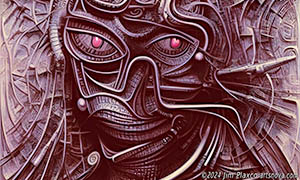
To illustrate this blog post, I combined two of the artworks created during the Live Art program in Photoshop and performed some additional image manipulation on them to create an abstract landscape. I also use this piece to illustrate A Gallery of Live Art Created at the Capricon Science Fiction Convention.

Referenced Links

Bookmark it:  Stumble It  Bookmark this on Delicious  Digg This  Technorati  Reddit Tweet It


New Art, a Poem, and Digital Art Reflections

Saturday, March 13th, 2010

Impression of Water Lily

I just added new art to my Nature Gallery. Impression of Water Lily is a digital semi-abstract impression of a water lily. This is what I hope to be the first in a series of evolving impressions of similar botanic pieces. My objective is to experiment with different digital techniques of representing various flower-like structures found in nature.

Regarding computer art, here’s a poem I’ve just written that in part reflects the intellectual challenges faced by the digital artist.

I really like computer art
Painting with pixels is sweet
But reading all those manuals
Is anything but a treat.

One advantage traditional artists have over their digital artist counterparts is that after all these years paintbrushes are still paintbrushes and pencils are still pencils. Given the static nature of their tools, traditional artists can focus on refining their mastery of their tools. The same is not so for the digital artist. It frequently happens that even before one can master a particular digital tool, or explore its full range of potentialities, a new version of that tool or another tool comes along to replace it and the learning process begins anew.

The tools I learned how to use when I was first exposed to digital art (computer art as it was then known) in the early 1980’s are extinct today. In fact, today I’m only using one of the tools that I learned and was using in the 1990’s. It is the one graphics software that I have used the longest. I started with Adobe Photoshop 5 circa 1999 but today’s Photoshop CS4 bears little resemblance to that first version.

I fully expect this rate of change to continue. As operating systems progress and change; as old hardware dies; as graphics software packages cease to be supported and their owning companies go out of business; and as new graphics software offerings supercede in functionality capabilities of older software; we digital artists will remain on the upgrade treadmill with our noses buried in the manual of our newest digital tool.

Bookmark it:  Stumble It  Bookmark this on Delicious  Digg This  Technorati  Reddit Tweet It


New Art: Emergent Hand

Thursday, February 4th, 2010

Emergent Hand
Emergent Hand

I had a tough time naming the newest addition to my Computer Art Gallery. Emergent Hand
started out as a landscape scene inspired by what I observed last year while visiting Bryce National Park in Utah. Upon completion of the piece I realized that I had created a hand. In fact, turning it sideways brought to mind that flying Blue Meanie glove from the Beatle’s movie Yellow Submarine. I found the ambiguity of the piece particularly appealing.

For more information about the art and to see a wallpaper sized version, visit the Emergent Hand web page.

Bookmark it:  Stumble It  Bookmark this on Delicious  Digg This  Technorati  Reddit Tweet It


To Be Anonymous Added to Computer Art Gallery

Wednesday, February 3rd, 2010

To Be Anonymous
To Be Anonymous digital art.

To Be Anonymous is the newest addition to my Computer Art Gallery. Looking at this piece you may find it ambiguous and you’d be right. The subject is anonymity. To the outside observer, everyone in this crowd is anonymous. However, inside this digital painting there is one who, while a part of the group, is separate from it. What you the observer need to work out is this: is that individual turned away from us while the crowd face us, or is it the crowd that has their backs to us and the individual who stares out at us anonymously.

Back tomorrow with another new digital painting.

Bookmark it:  Stumble It  Bookmark this on Delicious  Digg This  Technorati  Reddit Tweet It


Atmospheric Disturbance Added to Computer Art Gallery

Tuesday, February 2nd, 2010

Atmospheric Disturbance computer art

I just finished adding another work of art to my web site. Atmospheric Disturbance is a piece I created earlier this month and which I’ve added to my Computer Art Gallery.

The piece came about as a consequence of considering the invisible turbulence that a particle, ball, or planet creates when moving through some intangible medium. Actually it all started with thinking about that old idea that there was an invisible ether that permeated all space and which would affect the speed of photons as they moved through that medium.

I added Atmospheric Disturbance to my Computer Art Gallery because of the tools and workflow used to create this piece. This piece was created using a combination of my own personal computer graphics software and Adobe Photoshop.

I must confess that one of the reasons that I make use of my own software dates back to a number of years ago when I would be walking through the art shows at science fiction conventions. At that time the range of graphics software used by digital artists was less diverse than today and I prided myself on being able to correctly identify the software the artist used in the creation of their artwork. Especially easy to identify were those pictures created using either Bryce or Poser.

To escape being typecast it seemed best to avoid using mainstream software - Adobe Photoshop being the principal exception. It also seemed like a good idea to diversify and to not become too dependent on any one software package - once again with Adobe Photoshop being the exception.

In the early days I would write using the C programming language. Once Java came along I began using that language. In fact I’m proud to say that I used Java to create the first (as far as I know) web accessible database of Martian feature names which included cross references to Viking images. Java has changed substantially since then. Some recent and useful books on graphics programming with Java are:

In addition to Java, I also make use of a great extension to Java called Processing. While the Java programming language can be pretty intimidating, that is not the case with Processing and I highly recommend it to anyone even remotely interested in doing their own graphics programming. To learn more visit the Processing web site.

I seem to be getting off topic here so to conclude, for a better view of Atmospheric Disturbance, you should visit the Atmospheric Disturbance web page which has a link to a wallpaper sized version of the image.

Look for another new art addition tomorrow

Jim.

Bookmark it:  Stumble It  Bookmark this on Delicious  Digg This  Technorati  Reddit Tweet It


June in Review: New Art and a Vacation

Friday, July 3rd, 2009

Self Portrait at Bryce Canyon National Park

I can’t believe the month of June went by without a single post to my blog but it was a very busy month. Following is a review of my activities for the month. I’ll write later about the drive crash that delayed this update.

It began with my return from the International Space Development Conference in Orlando FL. I arrived at the conference hotel on Wednesday and departed on Sunday with my only excursions out of the hotel being to grab some fast food as a low cost alternative to the hotel restaurants. At the conference I gave a formal presentation on space solar power and an informal presentation about the National Space Society to a group of students from India. I also was a participant in the conference’s space art show. That show was a terrible disappointment to me. There were only a few artists participating and we were hidden in a back corner of the exhibit room with no signage indicating that there even was an art show or that space art was on display. There were also other problems which I won’t go into detail on here. I did take a number of photographs and submitted a selection of them to Ad Astra magazine for possible publication - several of which will appear in the magazine’s next issue.

The next week was spent playing catch-up and preparing for a two week trip to Arizona and Utah. While in Arizona we visited my Mother and did a number of jobs for her around the house. We then took off for a quick tour of three national parks. Our first stop was the Grand Canyon. From their we proceeded to Bryce Canyon National Park in Utah and after a couple days there headed south to Zion National Park. So which was our favorite national park? A poll of the family afterwards gave the award to Zion National Park with Bryce coming in second and the Grand Canyon bringing up the rear. I will write in more detail about my experiences at each of these parks at a later time.

Upon returning home, it took me some time to catch up with email. I also went back to work on my web site. In addition to making a number of minor cosmetic changes to the site and correcting some previously undiscovered errors, I spent some time doing SEO (search engine optimization) work. Earlier in the month I had purchased the book The Truth About Search Engine Optimization by Rebecca Lieb. I’m only half way through the book but am quite impressed with what I’ve seen so far and am using its advice to improve my own site’s standing in the search engines.

In addition to the aforementioned site maintenance, I’ve also added two new art galleries. The first is a Computer Art Gallery featuring art that combines elements of algorithmic art with freehand digital painting. All the art in this gallery will have been created using interactive algorithmic software of my own design.

The second gallery is a Space Art Gallery featuring art that commemorates human space exploration. I previously had a Space Art Gallery that contained astronomical art. All of that art, depicting astronomical scenes including planets, moons, nebula, and stars, has been migrated to a new Astronomical Art Gallery.

I also prepared an application and submission package for participation in a corporate art gallery program. My inclusion in that program is a long shot as none of the artists in that program are digital artists nor does my artistic style match that of the other artists. However, nothing ventured nothing gained.

The Illustration

The picture I used to illustrate this post is a self portrait taken at Bryce Canyon National Park. This photograph was taken about an hour after sunset. With my camera on a tripod, I set my camera to its slowest ISO speed and the lens aperture to its widest opening. Opening the shutter for a 13 second exposure, I had ample time to amble around to a position in front of the camera after several seconds of exposure had already elapsed. I remained in the field of view for several seconds before exiting the scene. The result was the ghostly effect seen in the photograph.

Bookmark it:  Stumble It  Bookmark this on Delicious  Digg This  Technorati  Reddit Tweet It