The National Space Society 2024 Roadmap to Space Student Art Contest
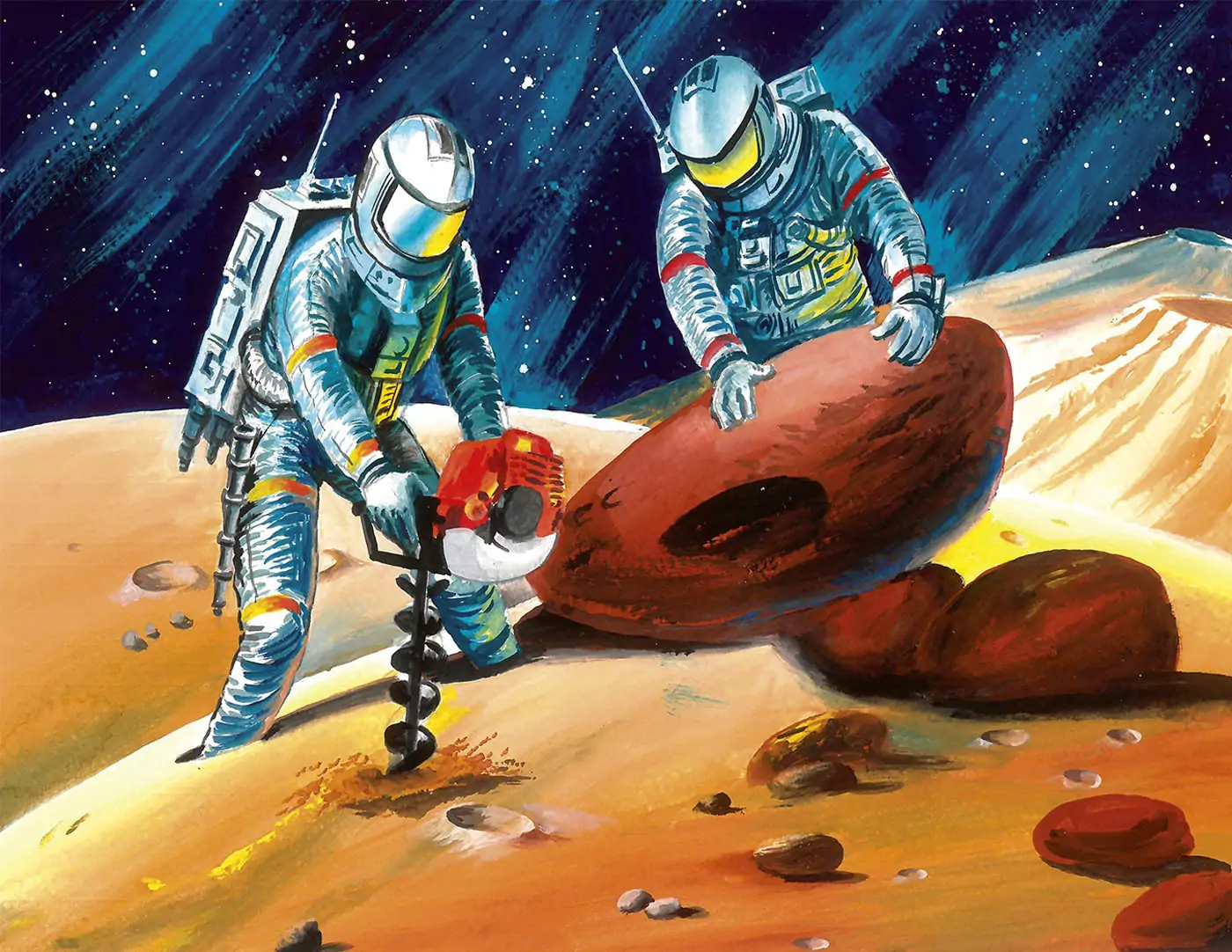
The Grand Prize Space Artwork in the 2024 Roadmap to Space Student Art Contest
Introduction
This year I had the honor of serving as the Operations Manager and Principal Art Judge for the 2024 Roadmap to Space Student Art Contest which was sponsored by the National Space Society (NSS) and cosponsored by the SmallSat Education Conference. The theme for this year's contest was Our Future in the Space Workforce and challenged student artists to envision a future where humanity has expanded its presence beyond the surface of the Earth and is engaged in work on this new frontier.
My history with this particular art contest was having previously served in various judging and support capacities. This is the seventh such contest and the second in which the SmallSat Education Conference was a cosponsor.
Art Contest Risks
Conducting this sort of art contest can be a risk for an organization. For example, this year I had been asked to serve as an art judge in another organization's space art contest that targeted children/students. This was that group's first attempt at having an art contest and it did not end well. Unfortunately that contest failed to attract any entries.
My own history with respect to art contests dates back to 2007 when I took on the challenge of managing the National Space Society's first ever art contest. Fortunately I was able to solicit a sufficient number of prizes that succeeded in attracting a large number of quality submissions, with the 12 winning artworks being used to illustrate an oversized space settlement art calendar that sold out - making it both a financial success and a marketing success.
For the 2024 Roadmap art contest, we did incur one very large risk that was unique to this year's contest - and it was a risk of my own making.
Managing the 2024 Art Contest
As the Operations Manager for the 2024 Roadmap to Space Student Art Contest, there were two major changes I made to the contest. The first was the introduction of an entry fee and the second was the creation of an ebook for the contest.
My proposal to require an entry fee for the contest was very risky as this was a contest for students and many of our entries came from countries other than the United States. However, I viewed the imposition of an entry fee as being a necessity based on the results of last year's contest. The 2023 contest attracted approximately 5,700 entries from around the world and our very small team of volunteers was totally overwhelmed by this number of entries. For my part, I had to view every submission and determine whether or not to accept it into the contest. I saw reducing the number of entries as critical in order to make the contest more manageable. This was a big risk but one I was willing to take. As it turns out, we received over 450 submissions in total, which was a far easier number of entries for our team to process.
My second proposal was to create a free ebook about the contest. The creation of this ebook would be contingent on there being a sufficient number of submissions and prizes awarded to make the effort worthwhile. As it was within the power of those judging the art contest to determine what prizes, if any, would be awarded, a final decision on whether or not to publish an ebook had to await the outcome of the judging process. However, because of time constraints, I felt that a model ebook had to be created in advance so that once the judging was complete, if we moved forward, the ebook could be quickly completed since placeholders were already in position. Fortunately, this worked like a charm and the ebook was quickly completed.
I viewed the creation of an ebook about the contest as being a clear positive for a variety of reasons. First, the ebook would contain every artwork submitted to the contest so that the students would be able to use it as a keepsake. Second it would provide wider visibility for the art that the students created. Third, it could be used as a reference point and promotional item for future contests. Lastly, it could be used as an example of both the education and space outreach related work that NSS does
Roadmap Space Art Contest Summary
The art contest was open to all full time students world wide who were between the ages of 10 and 25, with submissions by younger students requiring parental consent. The student submissions were separated into four age categories:
- ages 10-13
- ages 14-18
- ages 19-22
- ages 23-25
The contest had a clear and well defined set of submission requirements. In conjunction with the submission requirements, the guidelines that the judges would use in evaluating the art were also provided to the students. The objective was that by providing the students with this combination of requirements and guidelines that the art judges would be using, the students would be able to better target their artwork to the contest's objectives.
In terms of the prizes awarded, the art contest could have one Grand Prize, up to 12 First Prizes, and an additional number of Honorable Mention awards. Or the contest might not award any prizes at all if the judges were of the opinion that none of the submitted artworks were of sufficient quality. While this was clearly stated in the contest's guidelines, we have, fortunately, never not awarded a Grand Prize and multiple First Prizes.
Generative AI Art Not Allowed
One of the art contest's submission rules was that no generative AI created art would be allowed. This was an obvious submission requirement as the objective was to get students to create their own original artwork, whether it was using traditional art tools or software tools, like Photoshop, GIMP, Krita, Blender, etc. Unfortunately we did get a number of submissions that had obviously been created using a generative AI. Curiously, the generative AI artworks submitted to this year's contest were much easier to spot than with last year's contest. Most dismaying was that some students who submitted artwork made using a generative AI claimed to have painted the artwork.
The Art Contest Prizes
For the 2024 contest, to acknowledge the time and energy that students devoted to their space art creation, we (the National Space Society and the SmallSat Education Conference) were able to offer a number of prizes. In brief the prizes consisted of the following:
- A $300 cash prize (Grand Prize winner only)
- Having their artwork printed on postcards and launched on a suborbital flight by a Blue Origin rocket with the postcards subsequently stamped for authenticity post-flight and then mailed to the student
- Having their art displayed at the 2024 SmallSat Education Conference
- The possibility of being exhibited at the 2025 International Space Development Conference
- The possibility of being displayed at other relevant venues during 2025
- A 1 year National Space Society student membership
- Publication of their artwork in the National Space Society’s Ad Astra magazine
- Complimentary copies of the Ad Astra magazine issue in which their artwork appears
- Having their art featured on the SmallSat Education Conference website
- Having their art featured on the NSS website in the 2024 Roadmap to Space Student Art Contest Winners Gallery
- Having their artwork considered for possible publication in various forms in association with NSS and/or the SmallSat Education Conference
- A Certificate of Merit Award
In addition, all students whose artwork was accepted into the contest received a certificate acknowledging their participation.
Judging the Art
As Principal Judge, I was responsible for doing the initial screening of all art submitted to the contest. This involved first determining whether or not the submitted art met our submission requirements. The second step of the initial judging was to determine whether or not the submission was of sufficient quality to be seriously considered as being a contender for one of the contest's prizes. For this segment of the contest I was assisted by Sînziana Balaceanu (from Romania) and Xavi Gonzalez.
The final round of judging, in which the prizes were determined, was carried out by myself and noted space artist Bryan Versteeg. The determination of which art would receive a prize - and which prize it would be - was a challenging task. We began this final round of judging by starting with the oldest age group and discussing the strengths and weaknesses of each of the candidate artworks in turn.
I was heartened by the fact that Bryan and I were in near complete agreement with respect to the awarding of the Grand Prize, the several First Prizes, and the Honorable Mentions.
The Grand Prize Artwork
The winner of the Grand Prize was the artwork titled Lunar Descent: The Astral Spiral Quest by Javaba S.S Narayana, a student at e-Techno School-Nandini Layout, India. This artwork won based on its strong graphic appeal and compositional simplicity. It also had something of a classic retro space art feel to it.
My Favorite First Place Artwork
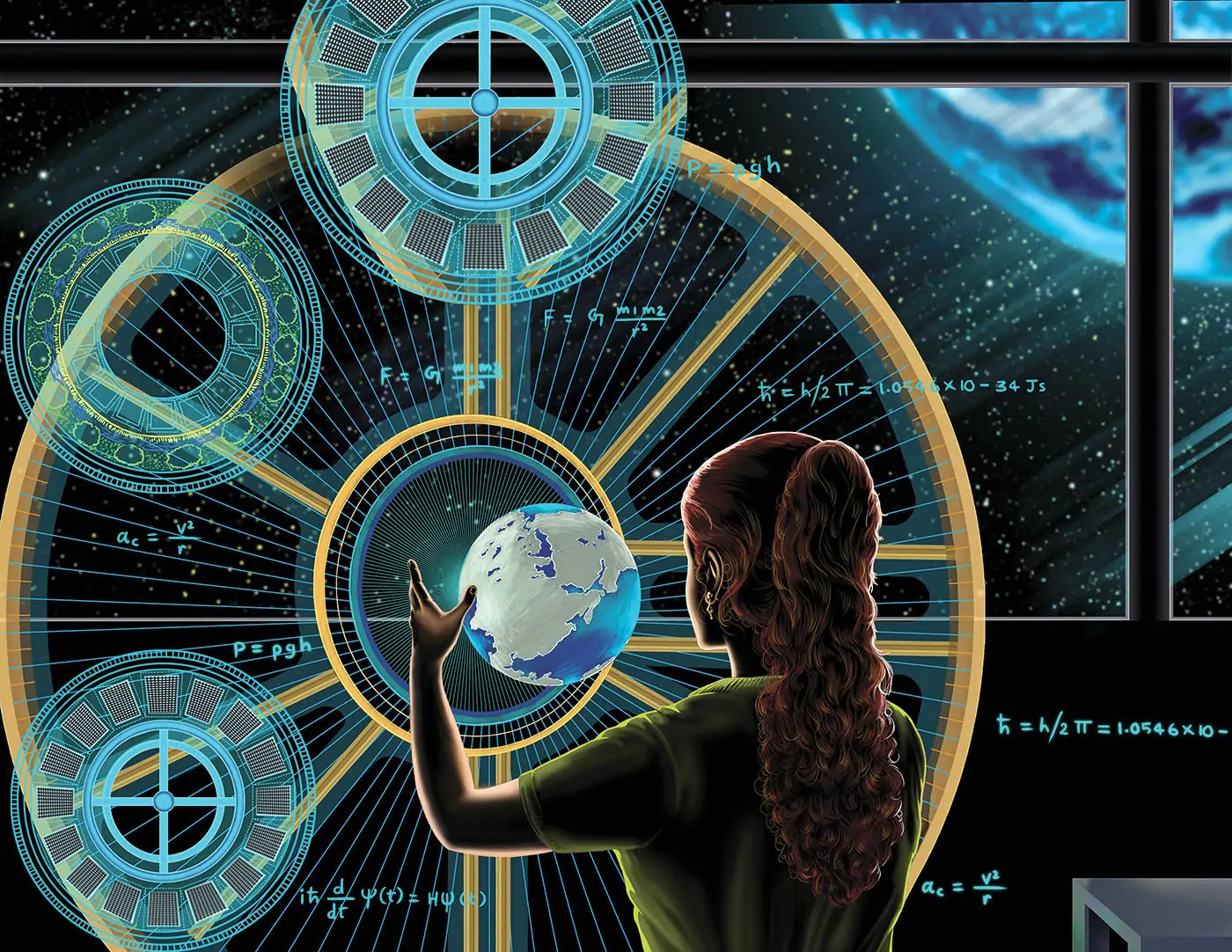
by Geyamrutha Poluru, Narayana Engineering College, Gudur, India
When it came to choosing an artwork to receive the Grand Prize, I was torn between Lunar Descent: The Astral Spiral Quest and Cosmic Classroom: Learning Among the Stars. Of the artworks awarded a First Prize, this one is my favorite. The setting is clearly somewhere in outer space, on an O'Neill space colony perhaps. The young girl is clearly working with advanced visual computing technology and the presence of the handwritten equations adds to informational/educational aspect of the artwork. Color, contrast, composition, and theme all worked very well together.
The Roadmap to Space Student Art Contest eBook
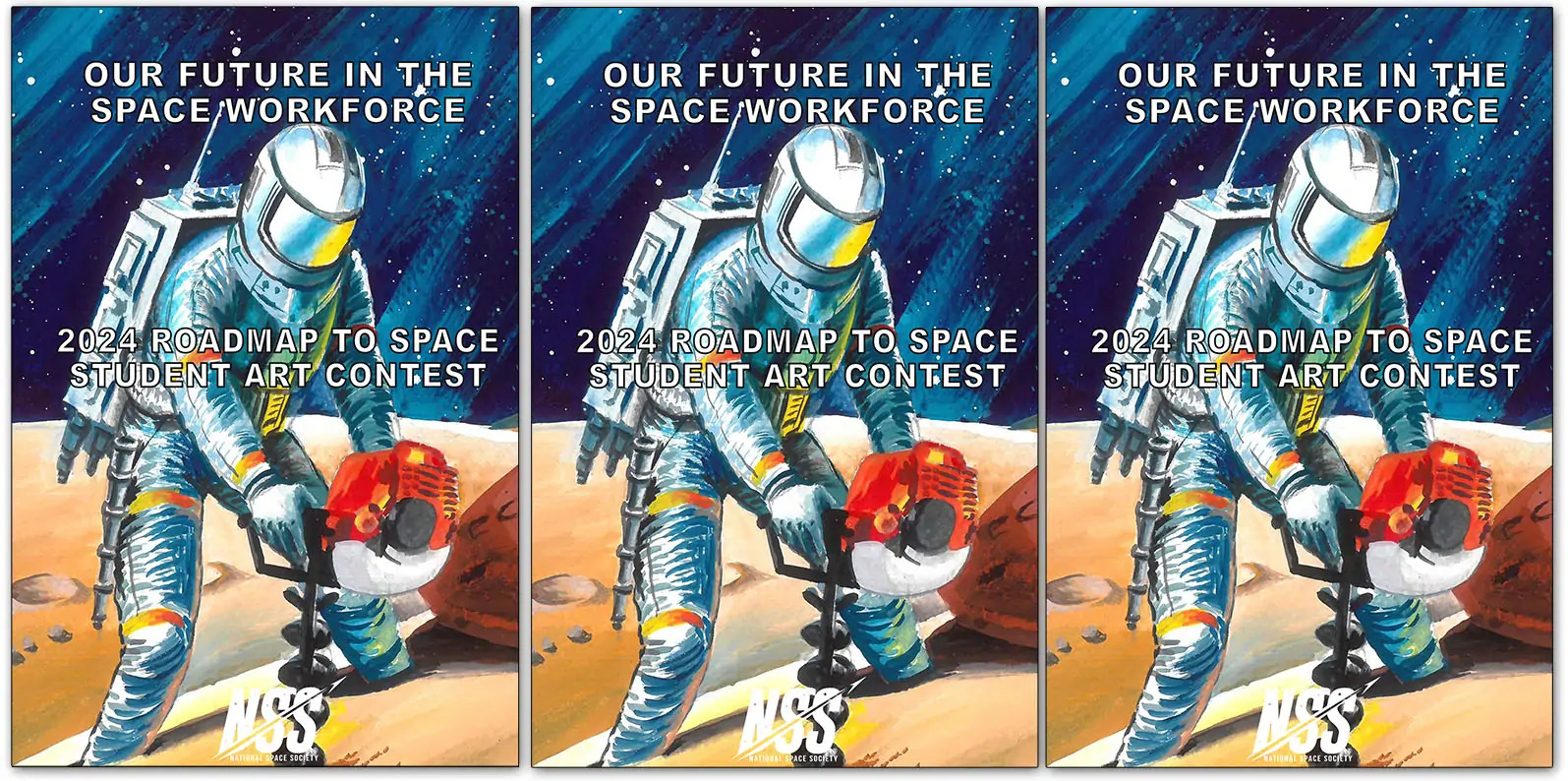
You can best learn about the contest and the art entries by downloading and reading the contest's ebook. The ebook is 53 pages long and 14.5 megabytes. The ebook was formatted as a 6x9 trade paperback. The ebook's table of contents is:
- About the Team
- About the National Space Society
- About SpacEdge Academy
- About the SmallSat Education Conference
- Introduction
- The Art Contest's Rules
- The Art Contest's Prizes
- Art Judging Guidelines
- Contest Commentary By Bryan Versteeg
- 2024 Grand Prize Entry
- First Prizes for Age Group 10-13
- Honorable Mentions for Age Group 10-13
- First Prize for Age Group 14-18
- Honorable Mentions for Age Group 14 - 18
- First Prize for Age Group 19 - 22
- Honorable Mentions Age Group 19 - 22
- First Prizes for Age Group 23-25
- Honorable Mention for Age Group 23 - 25
- Artwork Submissions By Students Aged 10 To 13
- Artwork Submissions By Students Aged 14 To 18
- Artwork Submissions By Students Aged 19 To 22
- Artwork Submissions By Students Aged 23 To 25
- Reflections on the 2024 Contest
- Web References
The Roadmap to Space Student Art Contest Live Presentation
I have created a presentation that provides background on the contest's history, talks briefly about the challenges of defining an art contest, and proceeds to focus on the best of the submitted art with an emphasis on the space settlement and space development challenges which that art addresses. This presentation was first given in January for a NSS Space Forum webinar. I will be giving an abbreviated version of the presentation at the 2025 International Space Development Conference in Orlando FL. If you are a representative of an organization that would like to host this presentation for either your members or a public audience, please contact me. The presentation is suitable for all ages and audiences.
The Plan for the 2025-26 Contests
Initial planning has begun for a 2025 contest which is designed around the 100th anniversary of Robert Goddard's first launch of a liquid fueled rocket. One aspect will be a longer submission period that covers more of the school year. There are some other plans for the contest that will be made public at the appropriate time. It is expected that the traditional Roadmap art contest will return in the fall of 2026.
Art Contest References
Following are links to websites associated with the space art and the Roadmap to Space Settlement Student Art Contest.
- Our Future in the Space Workforce: A Review of the 2024 Roadmap to Space Student Art Contest NSS Blog Post
- Roadmap to Space Student Art Contest
- Gallery of winning art for the 2024 Roadmap to Space Student Art Contest
- Wikipedia Space Art page
- Wikipedia List of space art related books
Update: Questions from the NSS Space Forum
On Jan. 23, 2025 I gave the presentation Student Visions of Space Settlement: The Roadmap to Space Student Art Contest at a National Space Society Space Forum Webinar. Following is a list of selected questions that had been submitted by attendees and my answers to those questions.
Question: What surprised you the most about the artwork submitted by students?
Answer: First, the lack of anime style submissions. I remember there was a period of time several years back when the anime style of illustration seemed to dominate the contest's submissions. For me, it was nice to see a return to a more representational style.
Second, in the past we had received a reasonable number of submissions from students using 3D software but we did not get any this year. This may have been due in part to the requirement that submissions were not allowed to include third-party 3D digital assets.
Question: Were there any recurring themes or creative approaches that stood out across multiple entries?
Answer: With respect to themes, we got fairly broad coverage of the relevant subject areas - although I was surprised to not see any entries dealing with space solar power given how much attention that area of space development receives - particularly when you consider the issues of climate change and our ever increasing dependence on electricity.
Question: How do you think artistic expression helps students engage with the challenges of space settlement?
Answer: It puts the student in the position of having to physically visualize both the environment and the associated technologies. That means having to research and think more seriously about the subject so that you can better understand what it is you are attempting to visualize.
Question: Did any student submissions present particularly unique or unconventional ideas for space habitats?
Answer: No. I didn’t see anything that departed from the existing body of thought. Whether it was an orbiting O'Neill space colony, a lunar base, or a base on Mars: the visualizations were representative of existing concepts.
Question: How did students balance scientific accuracy with artistic creativity in their work?
Answer: There is no simple answer to that. It was clear that some submissions paid little heed to physical reality while others did seem to adhere to established and existing knowledge. For others, it was impossible to tell based on the artwork's subject and setting.
Question: Why is art an important part of space advocacy and education?
Art is a powerful form of propaganda. Art has long been, and will continue to be, used as a vehicle for marketing ideas. Space art played an important role in helping lawmakers, and voters, visualize what a particular NASA program would look like when it was going through the approval process. In terms of education, you are rather expecting students to think critically about the subject of their art. And by critical, I mean analytical. The first step in the creative process is to become well informed about the subject your are being asked to visualize. I feel that this analytical component of art helps students to become better thinkers.
Question: Which aspects of space settlement — such as ISRU, healthcare, or communications — seemed to resonate most with students?
Answer: If you use the number of submissions as a proxy for resonating, then healthcare was far ahead of ISRU and communications. And extending the definition of healthcare, there were also submissions that featured robots receiving care from a human who appeared to be a doctor. And given the unknowns associated with the long-term off-Earth habitation, it was gratifying to see as many submissions as we did that dealt with health-related issues.
Question: Were there any surprising solutions depicted in the artwork that could actually be viable in the future?
Answer: I didn’t see anything that could be described as being an original solution. But then the students were not being asked to create artwork that depicted a solution to a problem.
Question: Will NSS continue to host similar contests in the future, and if so, how might the competition evolve?
Answer: NSS regularly hosts a number of contests and has done so for years. And I expect that the Roadmap art contest will be back again in 2026, since for 2025 our focus is going to be on a set of three student art contests done as a part of the 100th anniversary of the first launch of a liquid fueled rocket by Robert Goddard in 1926.
Question: Are there plans to exhibit the winning artworks beyond the eBook, such as in museums or space-related conferences?
Answer: With respect to what is outlined on the contest's website, there is the possibility of display but specific plans for the logistics of it all would need to be put in place if and when the opportunity does arise.
Question: What advice would you give to young artists who want to use their skills to contribute to the space industry?
Answer: The first priority would be to develop your technical illustration skill set and style. The second thing would be to practice executing a lot of technical illustrations – drawing and painting machinery rather than landscapes. The space industry needs artists who are conversant with the language of engineers and can translate that into visionary representations of the product in question - be it a rocket, a spacesuit, or a lunar lander.
Question: How can I use the knowledge to judge student projects on Feb 15 in Dallas, TX
Answer: First, the better defined your expectations are for the subject matter of the art, the easier it will be to judge the art. That means having a well-focused set of expectations for submissions. The second is to have several judges. When judges are in agreement, you can be pretty sure that your call is the right one.
Question: In how many levels (will) the contest be conducted and what is (the) maximum number of students who can participate, (I) want know the details.
Answer: Every contest is different. For the Roadmap student art contest, we’ve gone with 4 groups. And that’s to try and keep the playing field level - we don't want a 7th grader having to compete with a college student. As to the maximum number of students who can participate, that depends on your ability to process the entries. For the 2023 contest, our small group of volunteers were totally overwhelmed with the thousands of entries that we received. That's why we instituted an entry fee for the 2024 contest - expressly to reduce the number of entries to a more manageable level.
Question: Let's talk about art competition - Space Solar Power Institute would fund an SSP construction/operations art competition...
Answer: I think that would be very useful, especially as we did not get a single space solar power related entry this year or last year.
Question: How to create an appealing submission?
Answer: No matter what art contest you enter, make sure that your artwork adheres to the contest's requirements and submission guidelines. It then is on the artist to create an artwork that is both imaginative and technically well executed. If you do those three things, you are well on your way.
Question: Will our ideas really be implemented
Answer: That depends on us and future generations to decide that space settlement is what we want to do and our willingness to expend the energy to make it happen. As to ideas contained in the art, it depends on whether or not the idea portrayed in your artwork is within the physical realm of possibility. For example, your artwork of a time machine may be well executed, but because it violates the basic laws of physics, it's not going to be implemented. And, in the case of the Roadmap art contest, because it is not a plausible concept, it will not be considered for an award.
Question: What were your inspirations?
Answer: Interestingly, it was space art, science fiction, and NASA’s Apollo program that got me interested in space – and it was computer technology and programming that got me interested in art as a consequence of my own experiments with creating computer art and using creative coding to develop my own art software.
Question: What is your favorite art medium?
Answer: In terms of viewing art, I have no favorite medium It doesn’t matter if its an oil painting, an engraving, a watercolor, a pastel, a pencil sketch, or a 3D digital render: it all comes down to the impact the artwork creates.
In terms of creating art, I am a digital artist and a creative coder – which allows me to create my own digital art programs. The digital medium is easily the best when it comes to artistic exploration.
Question: How was it determined whether or not the art was drawn by the submitter?
Answer: We used a variety of methods and tools to determine whether or not the artwork was an original work. Now what we couldn't know was whether or not the student created the artwork or if it was done for them by a sibling or a friend. We rely on the student's integrity for that.
Question: WAS there a variety of media used?
Answer: Yes, there were a number of art media used which I felt made the submissions that much more interesting.
Question: Was any abstract art allowable?
Answer: No. Unlike representational art, abstract art has no concrete meaning. All art submitted to the contest was supposed to be representational per the submission requirements of illustrating what life would be like on the space frontier.
Question: If this contest of art is to be done in the future, should an art teacher serve as a judge?
Answer: We actually did have teachers participating as judges - though they had not been art teachers.
Question: What determines the sophistication of the art?
Answer: I consider the determinant of the art's sophistication to be the competence associated with its technical execution and the number of objects the composition contains, as well as the amount of detail contained in the various objects.
Question: Did any of the submissions show evidence, on the part of the students, that they understand that systems and technologies intended for space settlements can be used (and may be necessary) to address issues here on Earth? I mean giving the detailed explanation of the Art work.
Answer: Based on several of the artworks that were submitted, it would be nice to think that the students made the connection that many of the technologies developed to support life off-Earth will also be useful to support life on Earth.
Question: I would like to know about (the) objective of (the) roadmap contest and how it (is) useful for young children
Answer: A key objective of the art contest was to get students thinking about our future in space, doing some technical research, and creating an artwork that illustrated the results of that research. This is all a part of STEAM. Space is inspiring and a future in space that includes regular people is even more inspiring. It’s my hope that the students who participated in the contest found inspiration and possibly were inspired to pursue an educational path that incorporates math and science.
Question: Do you think that art including images of humans are more influential in promoting the idea of space settlement?
Answer: Yes because we relate best to other humans. As an example, many years ago I had the opportunity to serve as a tour guide for a dual tractor-trailer space station exhibit that was at the Adler Planetarium as a part of a nationwide tour. When we were in the habitation module mockup, people asked a lot of questions about eating, sleeping, bathing, etc. - all the things we routinely do. However when taking these same people through the science module, they had no questions - they just didn't relate to that aspect of the space station. So showing people engaged in life on the space frontier is important in helping people to relate to what that life might be like.